HPLC is distinguished from traditional ("low pressure") liquid chromatography because operational pressures are significantly higher (around 50–1400 bar), while ordinary liquid chromatography typically relies on the force of gravity to pass the mobile phase through the packed column.
High-performance liquid chromatography or commonly known as HPLC, is an analytical technique used to separate, identify or quantify each component in a mixture. The mixture is separated using the basic principle of column chromatography and then identified and quantified by spectroscopy.
High-performance liquid chromatography (HPLC) is a broad analytical chemistry technique used to separate compounds in a chemical mixture. These separations utilize the pressure-driven flow of a mobile phase through a column packed with a stationary phase.
Only compounds dissolved in solvents can be analyzed with HPLC. HPLC separates compounds dissolved in a liquid sample and allows qualitative and quantitative analysis of what components and how much of each component are contained in the sample.
High-Performance Liquid Chromatography (HPLC) is a core technique in analytical chemistry. Routine HPLC is often used for analysis in laboratories that perform pharmaceutical drug development, quality control (QC), and quality assurance (QA), as well as food and environmental testing.
Basic Chromatographic Concept: HPLC operates on the principle of differential partitioning of compounds between a mobile phase (liquid) and a stationary phase (solid adsorbent material packed in a column).
How Does High Performance Liquid Chromatography (HPLC) Work? High-Performance Liquid Chromatography (HPLC) involves a solvent reservoir and a high-pressure pump to control the flow rate of the mobile phase.
The HPLC detector, located at the end of the column, detects the analytes as they elute from the chromatographic column. Commonly used detectors are UV-spectroscopy, fluorescence, mass-spectrometric and electrochemical detectors.
High performance liquid chromatography (HPLC) is a suitable method for the analysis of a wide range of application areas. Here, we describe the principle of HPLC and introduce to the most important components in an HPLC system and the factors that determine the success of a measurement.
High Performance Liquid Chromatography (HPLC) is a fundamental analytical and preparative technique known for its superior separation ability and precise results.
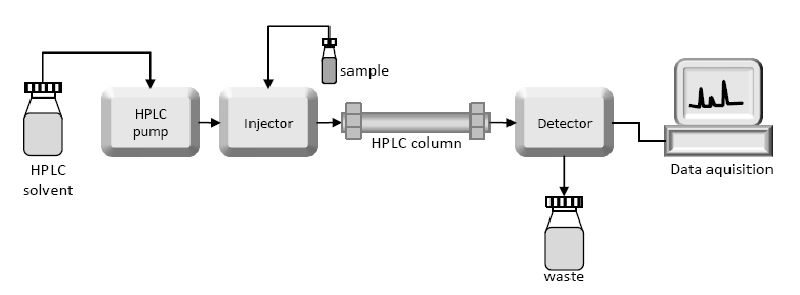 The HPLC detector, located at the end of the column, detects the analytes as they elute from the chromatographic column. Commonly used detectors are UV-spectroscopy, fluorescence, mass-spectrometric and electrochemical detectors.